On the Decision made by the EU sanctioning Colonel J. Baud and on the Decision made by Augustus sanctioning Ovid
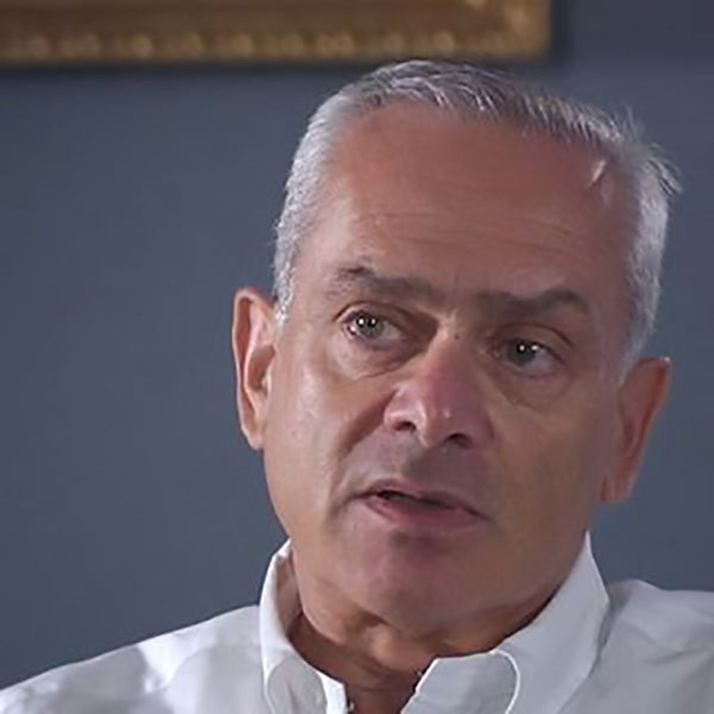
Jacques Baud. Photo: Max Milo Editions
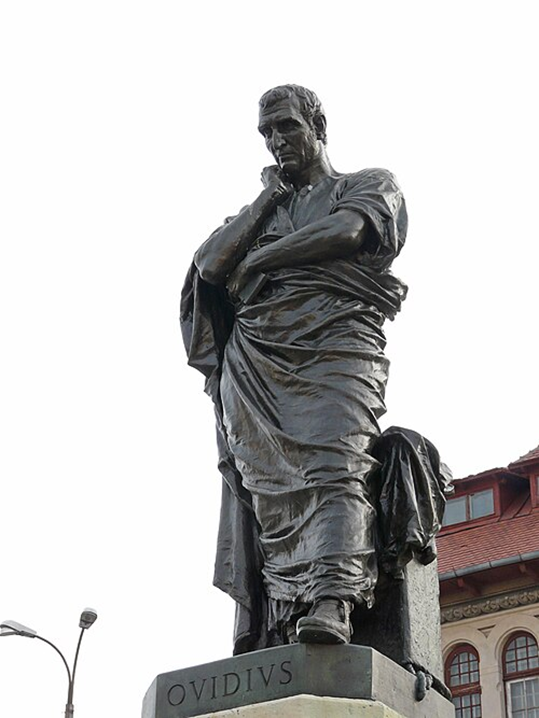
Statue of Roman poet Ovid in Constanţa. Photo: Wikimedia Commons
In the Decision by the European Union Council of Ministers the EU has shown itself as an entity which lacks the most elementary basics of a judiciary worthy of any legal system respectful of the Rule of Law: a) a due process, which should include the hearing and the allowance for the proposal of evidence or proves by the defendant and also the possibility of a second instance, i.e., the right to appeal against the decision adopted by the first instance authority; b) freedom of speech, meaning no other than the right of every person to express its opinion, especially when it is against or opposed to an act, a law, a decision or any manifestation coming from a government.
The above said applies to every individual, for anyone no matter its personal conditions, but not being enough, as there has to be a check and balance provision able to facilitate the vigilance and control of all the branches of power of the State, in our case a gigantic entity consisting in a supranational bureaucracy that gathers and overpowers on many important issues the powers of the State members assembled in its organization. This check and balance consist in the attribution given to a branch of Power of the State to control the constitutionality or the legality of the acts, orders ant decisions adopted by another power of the State.
But not only, for that would not be sufficient; when we talk about the need of check and balance what this is aimed to is to protect the minority and, moreover – and not the less, to protect the individual from the democracy, in other words, the individual from the government of the majority or, yet in other words, to protect his rights as an individual from the tyranny of the majority. Let’s not forget that these are the main purposes of the Bills of Rights, of the Constitutional Fundamental Rights and of the International Human Rights.
Yet the problem in this affaire concerning Colonel Baud’s punishment by the EU’s Decision comes not only from the previously said but by the fact that the EU cannot be considered as a democratically constituted institution, instead on the contrary, as a gigantic bureaucracy, the kind referred by Thomas Hobbes as a Leviathan, something too big and complex as to be able to be subject to control by the public and, also, to be regarded as a sort of Commonwealth not of independent States but of subjected States in which, at the end, those finally submitted are the peoples of those countries.
Colonel Baud’s Case, in fact, more than a case we can call it a file, in the sense that it would not comply with the most elementary and minimum requirements of a proper legal case in conformity with the Rule of Law, i. e., with the guarantees that should be provided to a person accused of infringing the law. The sanction was adopted by Councill Decision (CFSP) 2025/2572, of December 15, 2025 (published in the Official Journal of the European Union on the same date, 15/12/2025), regarding art. 29 of the Treaty on E.U. and having regard to the proposal from Kaja Kallas, the High Representative of the E.U. for Foreign Affairs and Security Policy, based upon the Statement of Reasons that literally goes as follows:
Jacques Baud, a former Swiss army colonel and strategic analyst, is a regular guest on pro-Russian television and radio programs. He acts as a mouthpiece for pro-Russian propaganda and makes conspiracy theories, for example accusing Ukraine of orchestrating its own invasion in order to join NATO.
Therefore, Jacques Baud is responsible for, implementing or supporting actions or policies attributable to the Government of the Russian Federation which undermine or threaten stability or security in a third country (Ukraine) by engaging in the use of information manipulation and interference.
Well, as anyone can notice – no need to be a lawyer – there are no facts described neither are evidences or proves given and valued in this “reasoning”, neither are them in any other part of the text of the Decision; even if one wants to be very lax on its critique to the foundation of this sanction by saying that there is at least, although weak, an exposure of a fact when it offers what it literally calls an «example»: “accusing Ukraine of orchestrating its own invasion in order to join NATO”, it turns to be an absurdity when you find that the quoted phrase is not from colonel Baud but from one of the main leaders of the Ukrainian government, from no other than Oleksiy Arestovych, as the interviewed colonel Baud himself stated in an interview by Daniel Davis1.
But, nevertheless, even if it was the case that this statement came from the accused itself’ speech or writing, there are no legal grounds on which the EU (or any national authority) could base such a sanction: we, the citizens, nationals or foreigners, we are all entitled to express our opinions, even if they are against the leaders of the EU or of the member States, and especially if our opinions are opposed to the acts, rules or decisions issued by those authorities. It is a right enshrined in article 19 of the Universal Declaration of Human Rights:
Everyone has the right to freedom of opinion and expression; this right includes freedom to hold opinions without interference and to seek, receive and impart information and ideas through any media and regardless of frontiers.
Of course, as any right, it has the limits inherent, by definition, to any other right, i. e., those bounds by other persons’ rights. In the case of the right of freedom of opinion and expression we find these bounds in the United Nations Covenant on Civil and Political Rights, whose article 19 establishes:
3. The exercise of the rights provided for in paragraph 22 of this article carries with it special duties and responsibilities. It may therefore be subject to certain restrictions, but these shall only be such as are provided by law and are necessary:
(a) For respect of the rights or reputations of others;
(b) For the protection of national security or of public order (ordre public), or of public health or morals.
None of the above-mentioned restrictions are found in Jacques Baud’s Case, none at all within the reasons given by the sanctioning Decision.
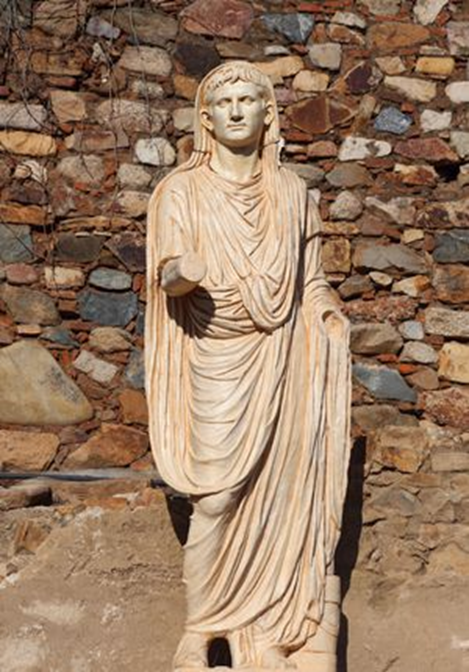
Augustus dressed in a toga, marble, 1st century CE; at the Archeological Ensemble of Mérida in Extremadura, Spain. Britannica
That is why we can argue that the treatment given to Colonel Baud is worse than the one given to Ovid by Augustus, who imposed him the relegatio, a simple exile, instead of the deportatio, which was a much graver sanction because it entailed the loss of citizenship and assets. But, just as the decision made by Augustus was an act of authoritarianism, adopted without the endorsement from the judicial authority and without having given the defendant the opportunity to present his own defense, so, as unbelievable as it may seem, the Council of the European Union has acted more arbitrarily and autocratically than the Roman Emperor3.
Colonel J. Baud interviewed by Lieutenant Colonel Daniel Davis: “(…) he merely quoted remarks made in 2019 by Olesiy Arestovich, then an adviser to President Zelensky, about the risk of war if Ukraine pursued NATO membership”. https://www.youtube.com/watch?v=VwNH3FLeZLA ↩︎
Paragraph 2 says: “Everyone shall have the right to freedom of expression; this right shall include freedom to seek, receive and impart information and ideas of all kinds, regardless of frontiers, either orally, in writing or in print, in the form of art, or through any other media of his choice. ↩︎
See Enríquez, J. A., in Ovidio Metamorfosis, p. 14; “An act of authoritarianism that Ovid will critique many times, while at the same time he will be complaining about the injustice of the punishment” (translated by the author of this article).↩︎